BAAJA Analysis: Protect 106
Tribal Nations Oppose BAAJA (S. 5653) as Amended
Bipartisan American Affordability and Jobs Act of 2026
The Ask: Vote NO on BAAJA Unless Issues with Section 106 Review, Including Tribal Historic Preservation Officer Oversight, Judicial Review, and Tribal Consultation,Clean Water Act, National Environmental Policy Act, Endangered Species Act, and Project Certainty are fully remedied. Work with Tribal Nations on a more honorable alternative.
The Bottom Line
The newly released Manager’s Amendment does not fix BAAJA: despite minor tweaks, it leaves intact narrowed Section 106 reviews, unilateral agency overrides of sacred places, THPO grant suspensions, and a ban on courts stopping unlawful projects.
Tribal Nations should not have to choose between infrastructure development and the protection of our cultural heritage. That is a false choice.
Tribal Nations support permitting reform, responsible infrastructure, and building and moving more energy. We have consistently been good partners in permitting.
Bringing Tribal Nations to the federal decision-making table early in the process speeds the permitting decisions by allowing Tribal experts to provide federal officials with information that can help shape the project to avoid legal pitfalls and harm to cultural resources.
BAAJA amends the NHPA, Clean Water Act, NEPA, Endangered Species Act, and Federal Power Act in a single 494 page bill, with no hearing, no committee markup, and no government-to-government consultation with Tribal Nations.
These changes are in deep conflict with federal trust and treaty obligations and fail to respect Tribal Sovereignty.
1. Narrows Section 106 Review and Reduces Tribal Participation
National Historic Preservation Act, Division B, Title III (Sec. 2301)
Why it matters: Section 106 review is a critical tool for ensuring Tribal Nations have a meaningful voice in federal decisions affecting historic properties, including sacred places and cultural resources. Unlike regulatory changes, BAAJA writes the narrowing into statute, where it is far harder to fix.
Narrowed definitions and new exemptions ("undertaking," "adverse effect," "area of potential effects") reduce when Section 106 review is triggered and continue to harm mitigation. For example, projects whose only federal involvement is a loan, grant, or other financial assistance are excluded.
Tribal consultation becomes box-checking. An agency controls the “Section 106” report, decides alone if a project causes harm to Tribal Nations’ historic properties, and fulfills consultation simply by replying in writing to Tribal comments on the report.
The federal agency remains the sole entity to determine whether historic properties are present and whether harm rises to the level of requiring consideration of mitigation measures, with no requirement to actually consider information submitted by Tribal Nations, despite Tribal Nations and our cultural experts being the only ones qualified to make that determination.
"Other considerations" can override sacred places. An agency may
decline to consider measures to avoid, minimize, or mitigate harm whenever, in its sole discretion, other considerations outweigh historic preservation, and courts must give that decision substantial deference.
Consultation on a statutory clock. If a Tribal Nation does not file substantive objections within 45 days, the agency need not respond to objections filed after.
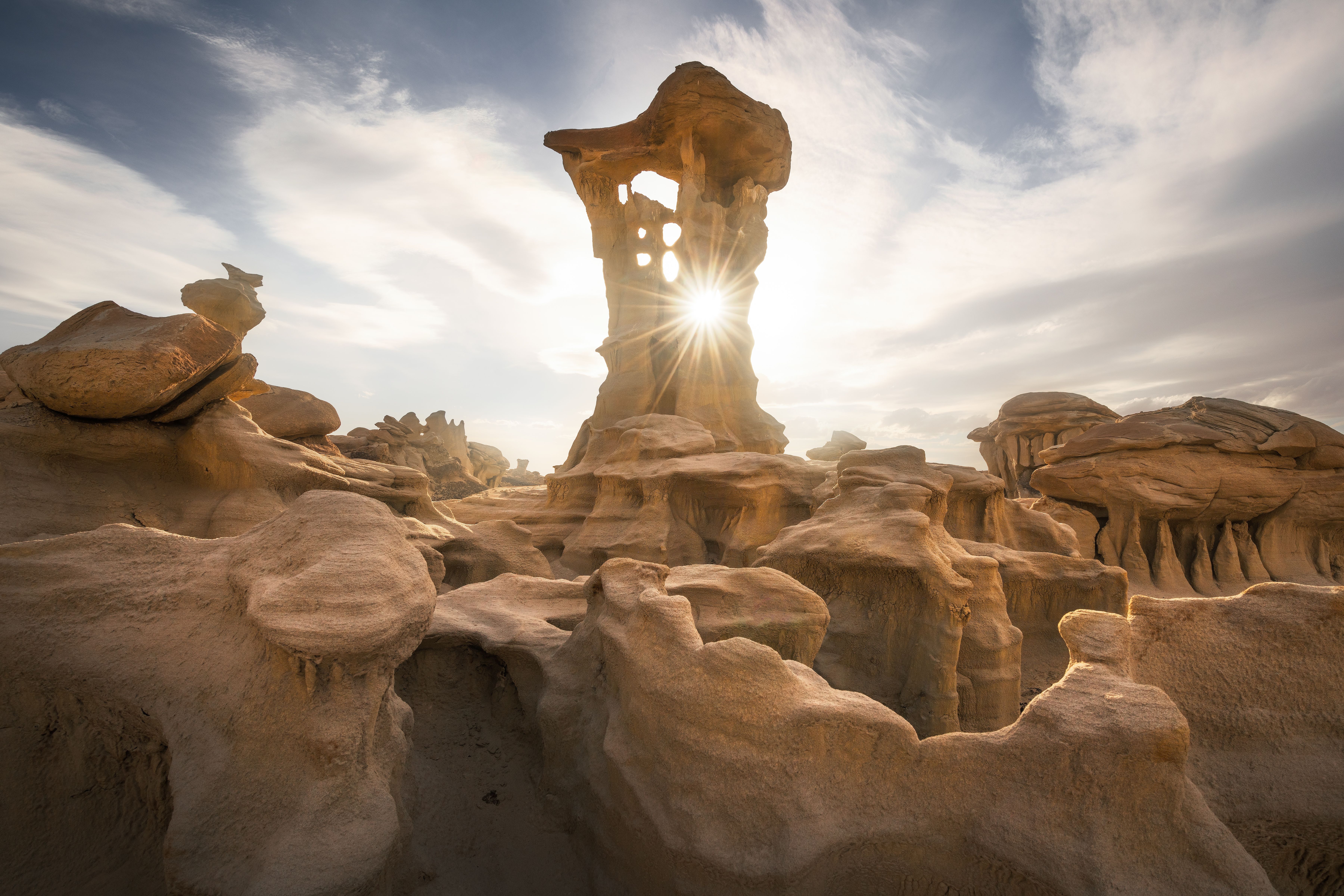
Greater Chaco Region, NM; Sunlight beaming through Alien Throne, 2019; Mason Cummings; The Wilderness Society
PLACES AT RISK
BAAJA would weaken protections for sacred places, cultural landscapes, cultural resources, waters, and lands, including Mount Taylor, the Greater Chaco landscape, Bears Ears, and the Caja del Rio, much of which lie outside reservation boundaries. Places like these are at risk across Indian Country:
Mount Taylor, New Mexico. A proposed uranium mine lies within the Mount
Taylor landscape, a Traditional Cultural Property sacred to multiple Tribal Nations. Under BAAJA, the portions on state and private land could fall outside the area of potential effects.
Greater Chaco, New Mexico. BLM has proposed revoking the mineral withdrawal protecting about 336,000 acres around Chaco, where at least 145 traditional cultural properties are documented. Under BAAJA, future leases, drilling approvals, roads, and pipelines would each be reviewed separately, where project-by-project review hides landscape-scale harm.
Bahsahwahbee, Nevada. An approved 214-mile transmission line passes near the Bahsahwahbee Traditional Cultural Property and Swamp Cedars area. Under BAAJA, review of long linear projects crossing federal and non-federal land would be confined to the federal segments.
Avi Kwa Ame / Spirit Mountain, Nevada. Listed on the National Register as a Traditional Cultural Property since 1999, Spirit Mountain could see small disturbances reviewed without regard to the larger sacred landscape.
A small construction footprint does not mean a small cultural impact.
2. Imposes Inappropriate Federal Oversight on THPOs
Tribal Historic Preservation Officers
Why it matters: THPO capacity challenges are the result of chronic federal underfunding and neglect. BAAJA responds to a problem of the federal government’s own making by penalizing Tribal Nations and shortening deadlines.
New federal evaluations of every Tribal historic preservation program, with undefined performance standards
Missed deadlines mean potential loss of THPO status and funding, including suspension of Historic Preservation Fund grants
Federal bypass of THPOs, allowing agencies to sign agreements with the Advisory Council on Historic Preservation in lieu of a THPO
Funding is a promise, not a guarantee. The $200 million for the Historic Preservation Fund under BAAJA is only “authorized to be appropriated,” and it replaces the current automatic deposit.
3. Limits Judicial Review and Removes Real Remedies
Why it matters: When federal agencies fail to consult, the courts are often a Tribal Nation’s last avenue to require the federal government to consider information that could protect its heritage. These are not nuisance lawsuits.
150-day statute of limitations to file suit
Narrowed standing and most claims begin in federal courts of appeals
Remand without vacatur or preliminary injunction is the only remedy for a Section 106 violation: a project keeps moving even after a court finds the NHPA was broken
Only 45 days for a Tribal Nation to raise substantive objections to an agency’s Section 106 report
A double standard, where the same bill gives project applicants a new right to sue agencies that miss consultation deadlines and directs courts to grant them injunctive relief
4. Restricts Tribal Authority to Protect Water
Clean Water Act §401 (Secs. 1202–1203) and §404
Why it matters: Tribal Nations must be able to require safeguards and deny certification when water quality requirements cannot be met.
New restrictions and heightened evidentiary burdens on Tribal and state water quality certification, substantially limiting ability to protect Tribal waters from harmful projects.
Conditions must be the “least burdensome option” and meet a “clear and convincing evidence” standard, neither defined.
Denials require proving a negative: that no alternative to denial exists
Expands the types and sizes of projects eligible for streamlined §404 nationwide permits, limits consideration of impacts on Tribal waters and resources, and makes it harder to challenge potentially unlawful permits in court.
5. Weakens NEPA and Sidelines Tribal Expertise
National Environmental Policy Act
Why it matters: NEPA is how Tribal Nations get early notice and a voice on projects affecting our lands, resources, and communities.
Narrows the definition of “major federal action,” so fewer projects trigger review
Agencies must ignore project alternatives inconsistent with the developer’s goals, other than “no action”
Removes “special expertise” as a basis for cooperating agency status, the very ground on which many Tribal Nations have earned a seat at the table
Limits consideration of Tribal environmental and cultural analysis
6. Undermines the Endangered Species Act
ESA Section 7
Why it matters: Many Tribal Nations hold treaty rights tied to species like salmon. Weakening ESA review weakens those rights.
Limits review of cumulative impacts on endangered species and constrains adaptive management
Redefines “best available science” so credible evidence of risk can be discounted if it cannot be predicted with complete certainty
Gives federal appeals courts exclusive jurisdiction over Section 7 cases, away from the federal district courts closest to the issue
Allows states to take over Section 7 consultation, leaving states primarily in charge of analyzing impacts to Tribal rights
7. Risks of Locking In Approvals, Even When They Are Wrong
Title IV, “Project Certainty”
Why it matters: Projects approved without meaningful Tribal consultation would likely be cemented in place for decades.
Risks locking in long-term fossil fuel development, drilling, and public land mining approvals
Strongly disincentivizes future administrations from reversing approvals even when new information, legal errors, or analytical errors come to light
Language is sweeping enough to effectively block future regulations affecting a covered project
Stifles judicial review of covered approvals
| Claim | Fact |
|---|---|
| BAAJA writes Tribal Nations into Section 106 review for the first time. | Tribal Nations already have a legal right to consultation under the NHPA. BAAJA would also require Tribal consultation, but in name only. |
| BAAJA funds Tribal historic preservation. | The funding is only authorized, not guaranteed.. And BAAJA would create new penalties for THPOs that could reduce their funding. |
| Section 106 review is what slows projects down. | 98% of the ~120,000 annual reviews find no adverse effect, and fewer than eight a year lead to litigation. Capacity, and federal agency failure to properly carry out Section 106 review in the first place, not consultation, are the bottlenecks. Real Section 106 review that allows Tribal experts to provide valuable information that can shape a project to avoid legal pitfalls and cultural resources speeds up project permitting. |
| Courts can still stop an illegal project. | For a Section 106 violation, the only remedy is remand while construction and destruction continue. |
A Better Path
Early, robust, and meaningful Tribal consultation can lead to stronger projects, faster decision-making, and more durable outcomes by helping reveal pitfalls from the beginning
Meaningful increases in funding for Tribal historic preservation and NEPA analyses will speed infrastructure deployment and bring greater certainty by ensuring Tribal Nations have the staff and resources they need to fully participate in Section 106 review.
Avoidance, minimizing, and mitigation requirements protect sacred places for future generations and help project proponents avoid costly litigation.
Permitting reform developed with Tribal Nations, at the table as sovereigns from the first draft.
The Ask: Vote NO on BAAJA. Work with Tribal Nations to Fix the Issues with Section 106 Review, Clean Water Act, NEPA, ESA, and Project Certainty.
STAND WITH US: Call Your Senators Now
The Senate vote is scheduled for Monday, November 9. Your call can make the difference.
Tell your Senators to vote NO on BAAJA (S. 5653) unless these issues are fixed. A call takes less than two minutes.
Call the U.S. Capitol Switchboard: (202) 224-3121
1. Call (202) 224-3121 and ask for your Senator by name. Not sure who your Senators are? Find them here.
2. Use the script below. You’ll likely speak to a staffer or leave a voicemail. Both count.
3. Call again and ask for your second Senator. Every state has two.
Your Call Script
Hello, my name is [your name], and I’m a constituent from [city, state]. [Optional: I am a citizen of [Tribal Nation].]
I’m calling to urge Senator [name] to vote NO on BAAJA, S. 5653, unless it is fixed. Tribal Nations support permitting reform, but this bill was written without a single hearing or consultation with Tribal Nations, and it puts sacred places, water, and Tribal sovereignty at risk and fails to speed up permitting decisions
Please tell the Senator to vote NO unless the bill:
Restores meaningful Section 106 Tribal consultation, so Tribal Nations, not federal agencies alone, help to determine what is sacred and what effects will be on those sacred places.
Ensures Section 106 review is triggered for our sacred spaces, including by amending the definitions of “undertaking” and “adverse effects”.
Removes the penalties for and federal bypass of Tribal Historic Preservation Officers.
Protects access to the courts, so projects can’t keep moving after a court finds the law was broken and sufficient Section 106 did not take place.
Preserves Tribal authority to protect water under the Clean Water Act
Keeps Tribal expertise in NEPA reviews
Maintains Endangered Species Act protections for wildlife
Drops the Title IV “project certainty” lock-in of approvals, even when they’re wrong and completed without sufficient review.
TRIBAL NATIONS DON’T STAND ALONE IN THEIR OPPOSITION TO BAAJA
Quotes from other prominent leaders opposed to BAAJA
“It’s permitting changes reach well beyond transmission, into mining, oil and gas, geothermal, hydropower, and offshore leasing. And finally, it gives project sponsors enforceable remedies while substantially limiting the ability of the public, states and tribes to stop unlawful approvals.”
***
“BAAJA gives federal officials broad discretion over permitting decisions but adds no safeguards to ensure that those decisions rest on a developed record, community input and sound science.”
***
“The bill limits the alternatives an agency must study to those that meet the goals of a non-federal sponsor (Sec. 1105). The practical result is that the sponsor frames the question the agency answers, and the agency has no statutory duty to test that framing against the record of affected tribes and communities.”
***
“BAAJA limits judicial review for the public, states and tribes while bolstering relief for sponsors.”
-Letter submitted 10/6/2026 by the Attorneys General of New Mexico, with concurring signatures from the Attorneys General of Arizona, Hawai’i, Minnesota, Nevada and Oregon
“Without amendment, some of the bill’s provisions will unnecessarily intrude upon states’ rights, harm critical resources in our states, and create uncertainty in ways that undermine the purposes of the bill. We further fear that these provisions will add to historical inequities and limit the ability of states – as well as Indigenous peoples and communities – to ensure appropriate environmental and public health protections for their residents.”
-Letter submitted 10/21/2026 from the Attorneys General of Massachusetts, California, Washington, Vermont, Delaware, Oregon, Maine, Illinois, and Arizona
“Sec. 1202 requires that state 401 certification (e.g., for hydroelectric licensing) conditions must be the least burdensome needed to maintain water quality, and the burden of proof for conditional grants of certification and denials of certification switches under this bill to be placed on states. This will make it more difficult for Washington to protect water quality
and increases the litigation burden on our agencies while undermining project permit certainty.”
-Washington Department of Fish and Wildlife’s Analysis of BAAJA
-Letter submitted October 30, 2026, by the Governors of New Mexico, Oregon and Washington
